
Why Growth Lives in the Tension Between Opposites
You have been told to choose. Be disciplined or be spontaneous. Accept reality or chase your dreams. Hold firm or let go.
What if the choice itself is the problem?
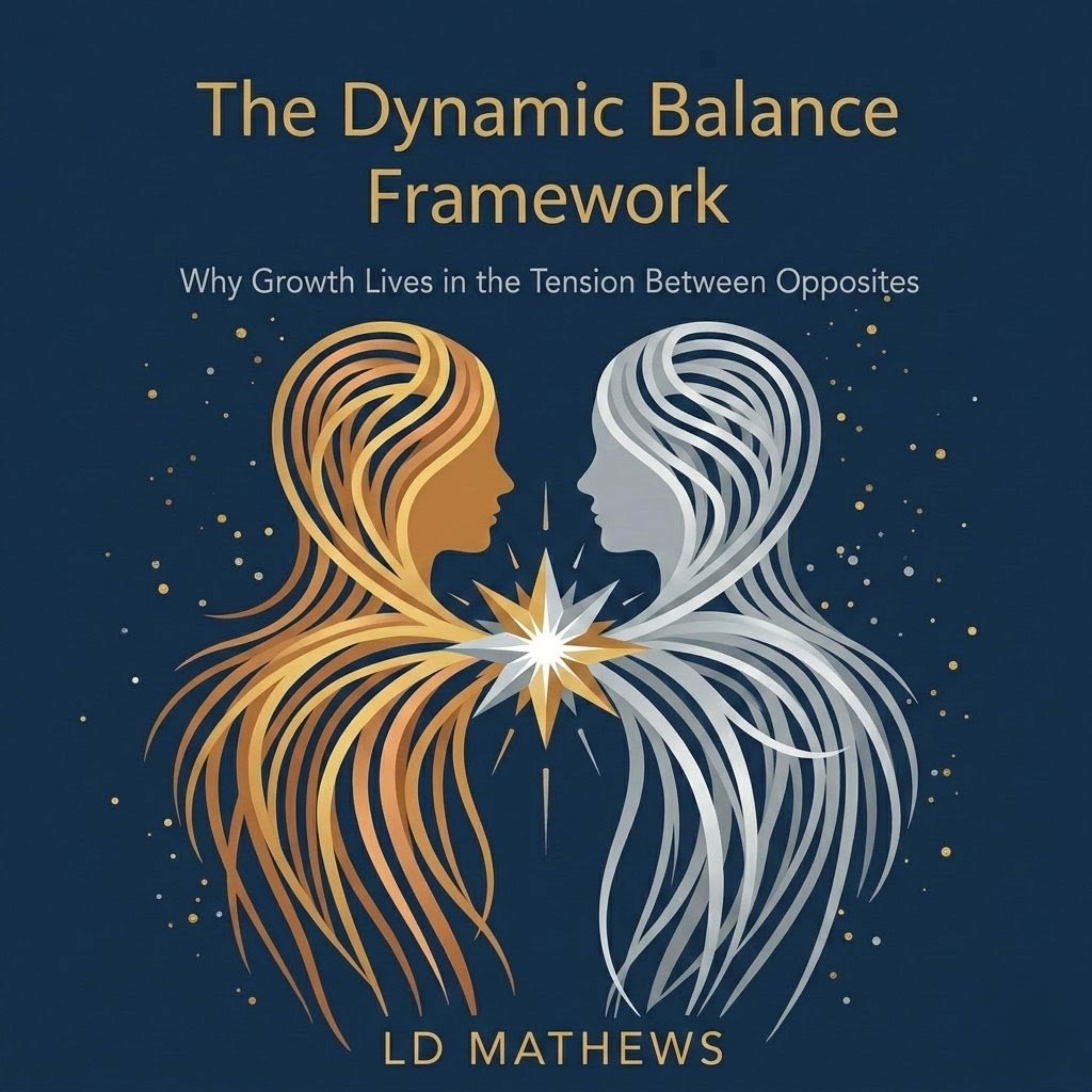
The Dynamic Balance Framework offers a different path. Not a set of rules. Not another prescription for the right way to live. A map for navigating the tensions that sit at the centre of every human life.
Across ten wellbeing domains and fifty dichotomies, this book examines the opposing forces we are taught to resolve but rarely should. Discipline and intuition. Acceptance and ambition. Solitude and connection. Boundaries and generosity. Each pair holds a truth that its opposite cannot replace.
Born from lived experience at the intersection of health systems, governance, and personal reckoning, this is not a self-help book that tells you what to think. It gives you a structure for thinking better.
Integration is not compromise. It is the capacity to hold more than one truth at a time and the wisdom to know which one a moment calls for.
If you are tired of choosing between incomplete options, this book is for you.
About the book
The Dynamic Balance Framework is a personal development framework structured around a single idea: growth does not come from choosing sides. It comes from learning to hold opposing truths at the same time.
The book identifies 50 dichotomies grouped across 10 domains of human wellbeing. Each dichotomy pairs two forces that are often presented as opposites. Discipline and intuition. Acceptance and ambition. Boundaries and generosity. Solitude and connection.
Rather than telling you which side is right, the framework asks you to develop the capacity to access both poles fully. It then trusts you to decide which one a given moment calls for.
About the author
LD Mathews
LD Mathews is a neurodivergent woman who has spent most of her life navigating systems that were not designed for how she thinks. She worked in health services and government, where composure was currency and precision was how you earned trust. She was good at both. For a long time she mistook that competence for wholeness, and built a life that functioned well without stopping to ask whether functioning well was enough.
She learned early to build workarounds that let her move through professional spaces without drawing attention to the effort it took to be there. She started in clinical practice and moved into health reform and governance, including prison health. What stayed constant was the gap between the person in the room and the person underneath.
She is a single parent of two sons who cannot be managed the way a room can. They needed her present, not competent, and the distance between who she believed she was and what she could offer was where the real learning started. She lost her father during the years this book was forming, and ended a relationship she could not break her walls down far enough to sustain. When she stopped believing that strength meant not needing anyone, the person she found underneath was less tidy and more alive than the one she had been performing.
Outside her professional life she volunteers with people at the margins, mentoring women navigating the justice system and working alongside people experiencing homelessness. Being alongside people rebuilding themselves after the structures around them had fallen away held up a mirror. She had not lost her freedom the way they had. But she had quietly given parts of it away, one reasonable decision at a time.
The Dynamic Balance Framework draws on established traditions in psychology, philosophy, and clinical practice, but it did not begin as a theory. It formed through lived tension and the refusal to accept that growth requires choosing one side of yourself over another. It is offered as a working map for anyone who has felt the pull of contradictions and wondered whether integration, rather than resolution, might be the more honest path.
She lives in Canberra. This is her first book.
